
Full Guide to Every Export and Import Trading Document, With Examples
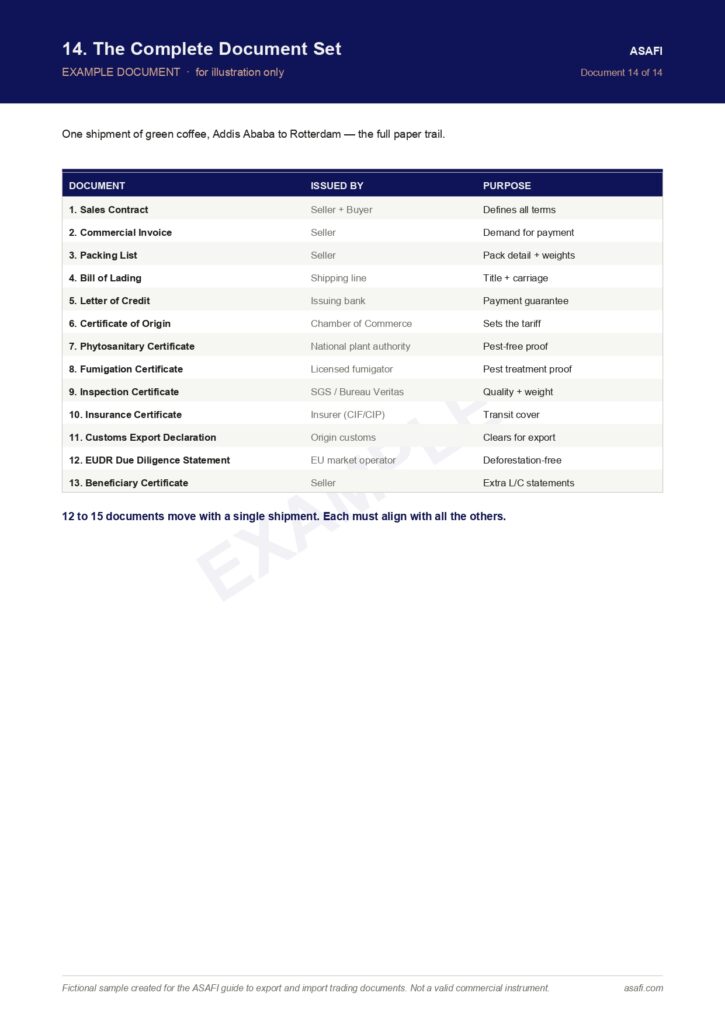
Every international shipment of agricultural commodities moves on paper. The cargo travels by sea. The ownership, the risk, the payment, and the legal compliance travel through documents. A missing certificate stops a container at the border. A single discrepancy in a letter of credit blocks payment on a million-dollar deal. A wrong date on a bill of lading transfers title to the wrong party. This guide covers every document used in agricultural commodity export and import trade — what it is, what it does, who issues it, and what it costs when it fails. Each one is shown as a ready example in the attached pack, built around a single shipment: 500 MT of Ethiopian green coffee from Addis Ababa to Rotterdam. The same contract number, weights, and values run through every document, the way a real set works.
1. The Sales Contract
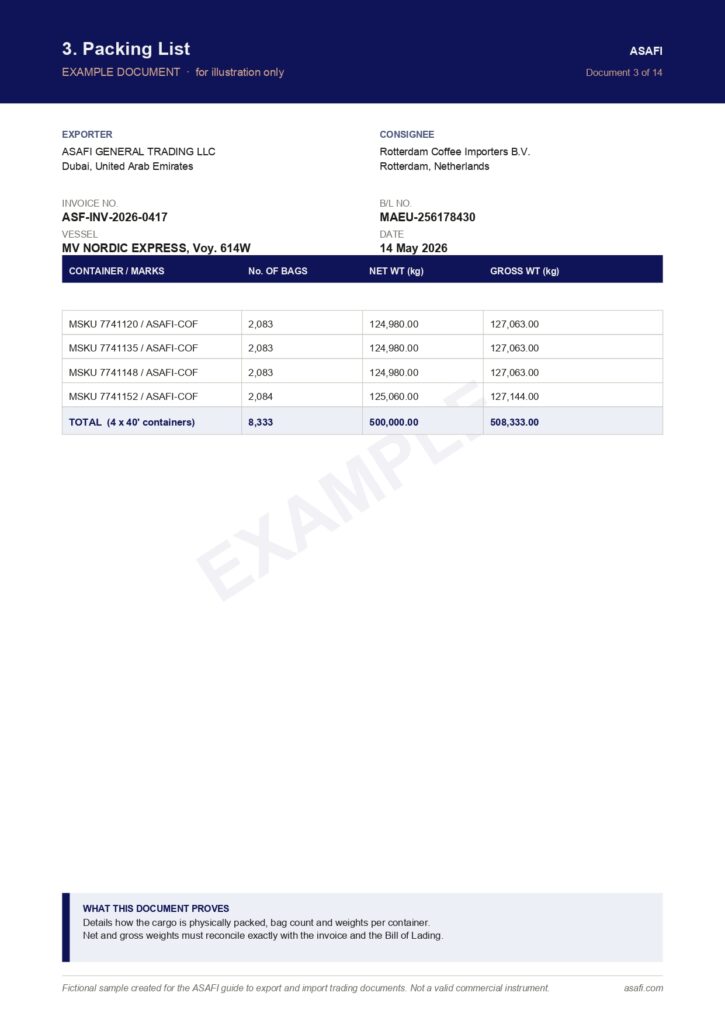
The sales contract is the foundation of every trade transaction. All other documents flow from it.
It covers commodity description and specifications, quantity, price, delivery terms (Incoterm), payment terms, quality tolerance bands, inspection and arbitration procedures, force majeure, and governing law.
The contract defines who bears risk at each stage and which inspection result is final. "Quality as per SGS certificate at origin, final" protects the seller. "Quality subject to buyer's approval at destination" protects the buyer. These phrases carry very different consequences, and each one determines who holds the exposure on a below-spec shipment.
Most contract disputes trace back to four under-negotiated clauses: quality tolerance bands, sampling procedure, dispute resolution jurisdiction, and which inspection result governs.
See the example: Document 1 in the attached pack.
2. The Commercial Invoice
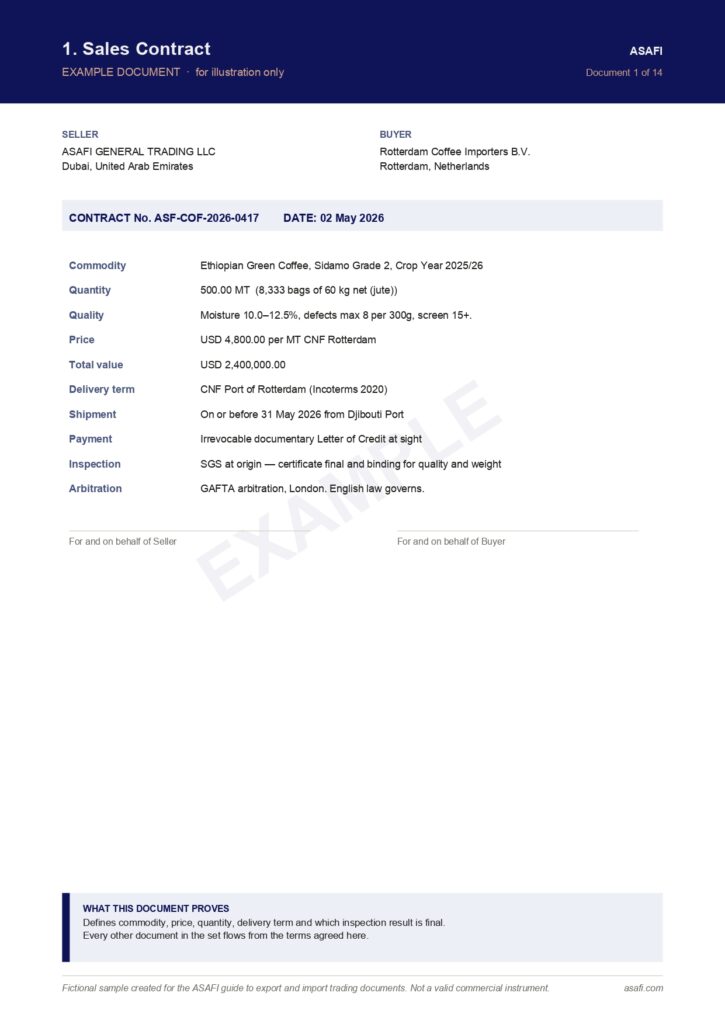
The commercial invoice is the seller's formal demand for payment.
It contains seller and buyer names and addresses exactly as written in the letter of credit, commodity description matching the contract word for word, quantity, unit price, total value, currency, delivery terms, payment reference, and country of origin.
In a letter of credit transaction, every field on the commercial invoice must match the L/C terms exactly. "Ethiopia Sesame Seeds" and "Ethiopian Sesame" count as different descriptions if the L/C specifies the first. A buyer address missing one word from the L/C is a discrepancy. Banks reject presentations on exactly these grounds.
See the example: Document 2 in the attached pack.
3. The Packing List
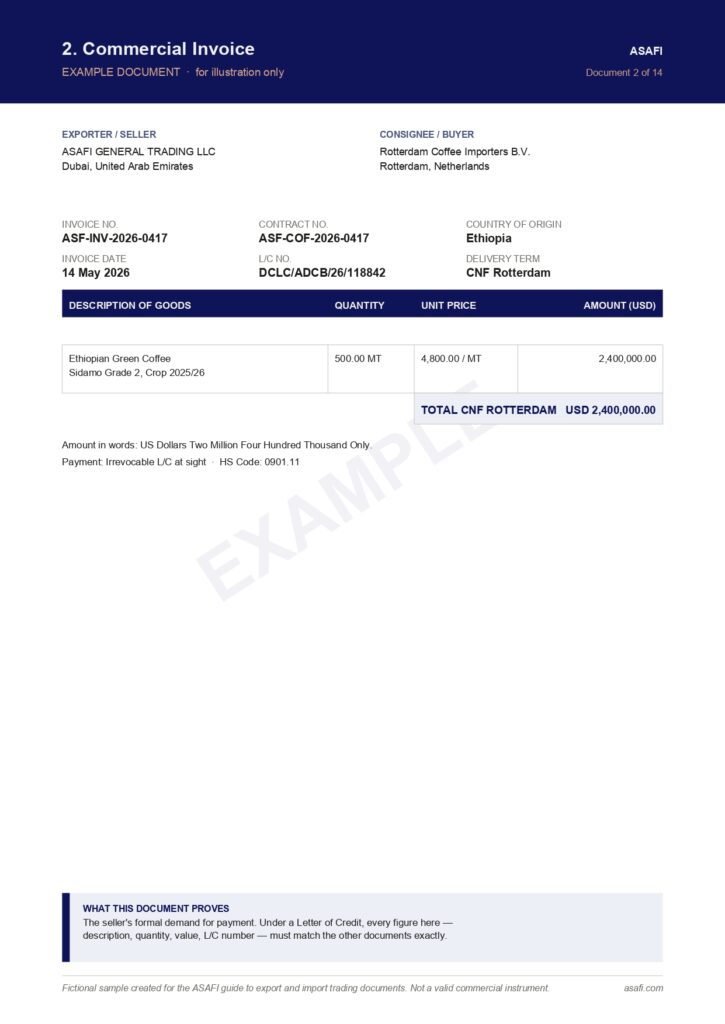
The packing list details how the goods are physically packed.
It contains the number of bags or containers, gross weight and net weight per unit, total gross and net weight, dimensions, container or seal numbers, and commodity description.
The packing list must reconcile exactly with the commercial invoice and the bill of lading. A net weight that differs by 50 kilograms between the packing list and the B/L is a documentary discrepancy under an L/C. The weight stated here is also what customs uses at destination for duty calculation.
See the example: Document 3 in the attached pack.
4. The Bill of Lading
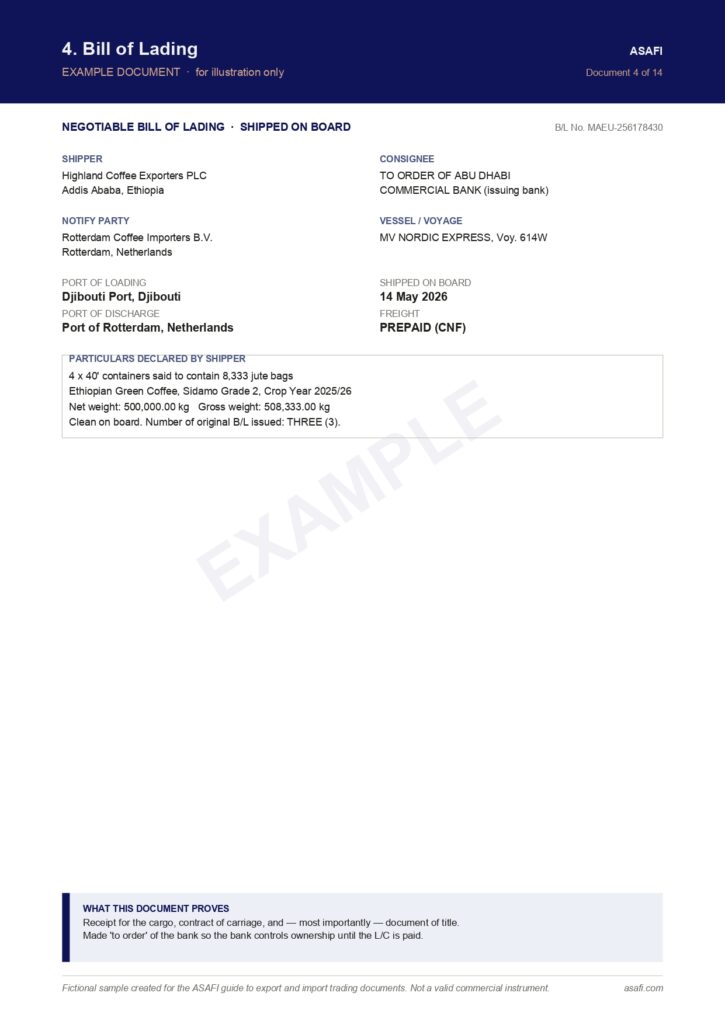
The bill of lading is the most legally powerful document in the shipment set.
It performs three functions at the same time. First, it is a receipt: the shipping line confirms it received the goods in the condition stated. Second, it is a contract of carriage between the shipper and the carrier. Third, and most importantly, it is a document of title: whoever holds the original negotiable bill of lading owns the cargo.
A straight B/L names a specific consignee and cannot be transferred. An order B/L is made out "to order" and transfers title by endorsement, like a bearer check. An order B/L is required in most letter of credit transactions because the bank needs to control title until payment clears.
Releasing the original B/L before payment confirmation transfers ownership to whoever holds it. This is how exporters lose entire shipments.
Key fields: shipper, consignee, notify party, port of loading, port of discharge, description of goods, number of originals issued, and date of issuance. The B/L date is the "shipped on board" date and must fall within the shipment period stated in the L/C.
See the example: Document 4 in the attached pack, made out to order of the issuing bank.
5. The Letter of Credit
The letter of credit is a bank's written undertaking to pay the seller, provided the seller presents a compliant set of documents within a defined timeframe.
The buyer instructs their bank (the issuing bank) to open an L/C in favor of the seller. The seller's bank (the advising or confirming bank) notifies the seller. The seller ships the goods and presents the document set. If the documents comply with the L/C terms, the bank pays — independent of whether the buyer can or will.
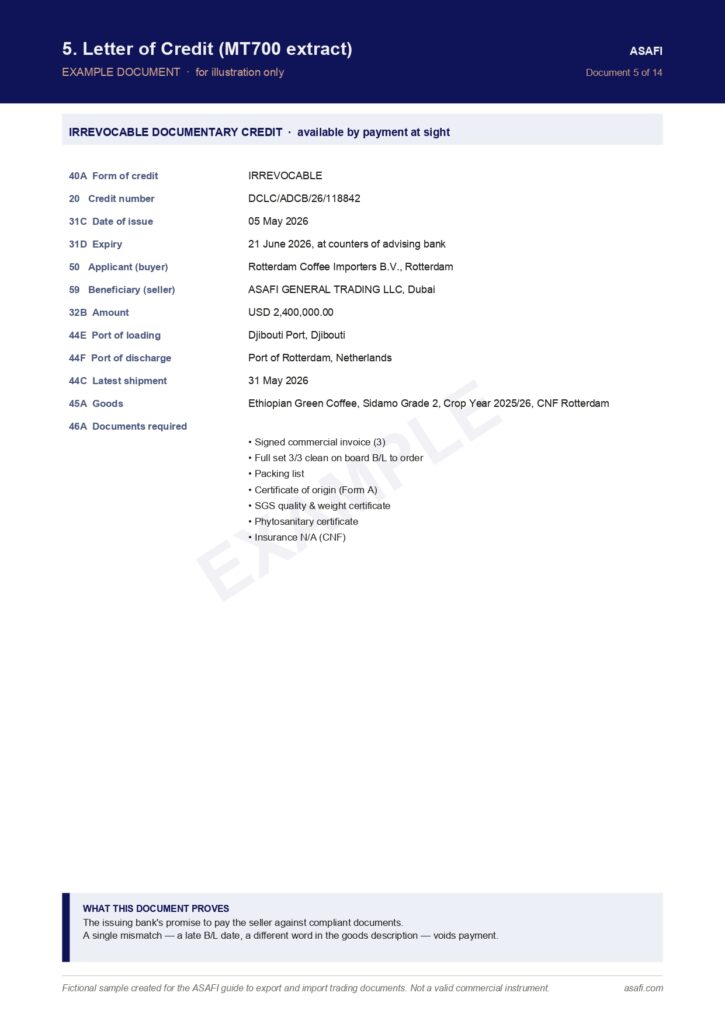
The L/C is governed by ICC rules (UCP 600). Under UCP 600, banks deal in documents, not goods. A document set that looks perfect but contains a single discrepancy gives the issuing bank grounds to refuse payment.
The most common discrepancies: late shipment date on the B/L, B/L not marked "on board," commodity description that differs from the L/C, missing documents, amounts that fail to match across documents, and presentation made after the L/C expiry date.
An L/C with a confirming bank adds a second layer of payment guarantee from the seller's local bank. This matters when the issuing bank sits in a country with transfer restrictions or political risk.
See the example: Document 5 in the attached pack, showing the key SWIFT MT700 fields and the documents the credit requires.
6. The Certificate of Origin
The certificate of origin declares the country where the goods were produced.
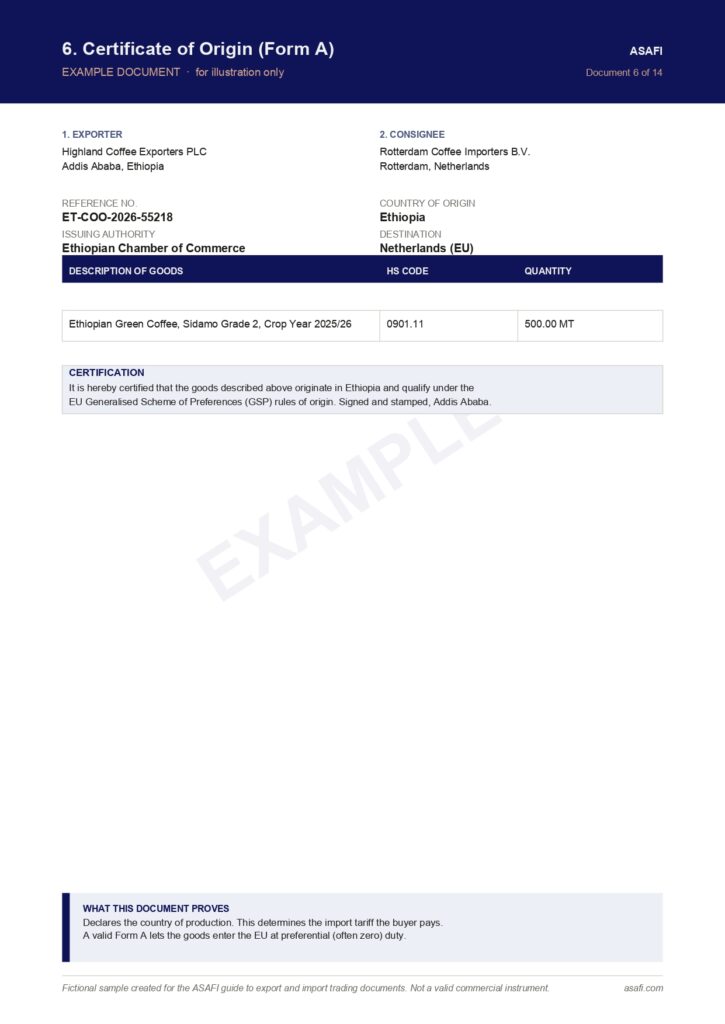
This declaration determines which import tariff rate applies at destination. Under the EU's Generalised Scheme of Preferences, the African Growth and Opportunity Act, ACP frameworks, and the UAE's CEPAs with African countries, goods with a valid certificate of origin from a qualifying country enter at reduced or zero duty. Without it, the full most-favored-nation tariff applies.
Forms used for EU preference: Form A (GSP), EUR.1 (for countries with EU Economic Partnership Agreements), and REX (Registered Exporter system declarations).
It is issued by the national chamber of commerce or a designated government authority in the exporting country.
The certificate is only valid if the goods satisfy the rules of origin for the relevant agreement — in most cases meaning they were wholly obtained or substantially transformed in the declared country. Re-exported goods that were not produced in the country cannot use that country's certificate.
A difference of 7.5% EU import tariff on a 20-tonne container of cashew kernels represents thousands of euros in buyer landed cost. The certificate of origin is a commercial document, valued well beyond its role as a formality.
See the example: Document 6 in the attached pack.
7. The Phytosanitary Certificate
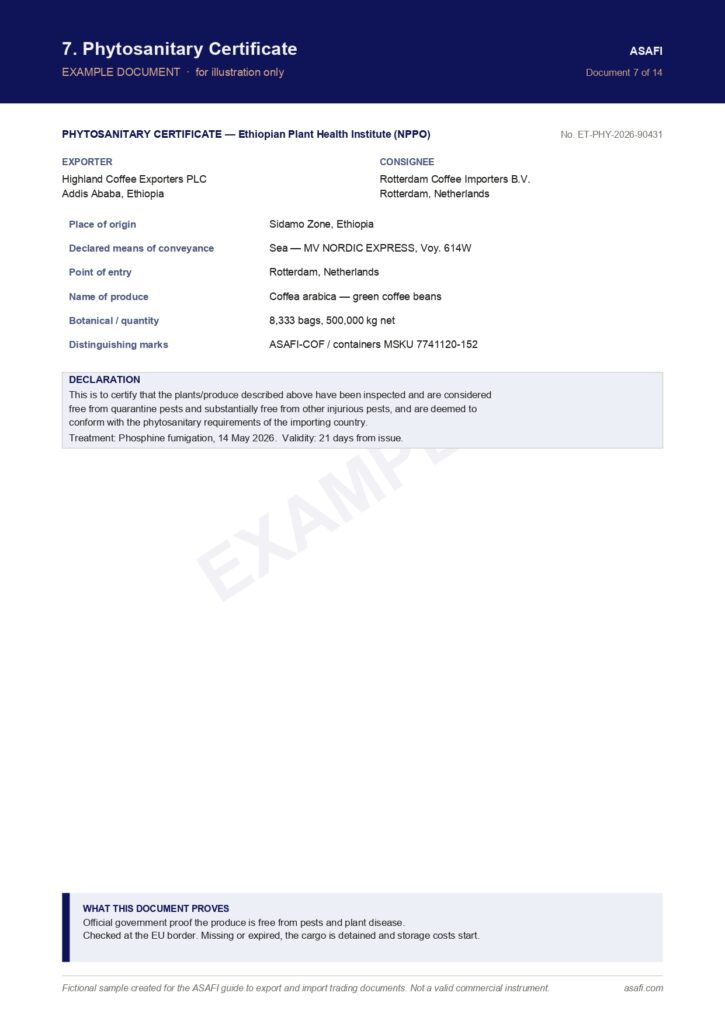
The phytosanitary certificate is an official government document certifying that a shipment of plant products has been inspected and found free from quarantine pests, regulated non-quarantine pests, and prohibited soil.
It is issued by the national plant protection organization (NPPO) of the exporting country — in Ethiopia, the Ethiopian Plant Health Institute; in Tanzania, the Tanzania Plant Health and Pesticides Authority.
It is required for all agricultural commodities including grains, oilseeds, pulses, coffee, and sesame.
EU border control posts inspect phytosanitary certificates on arrival. Failure grounds include a certificate issued by an unrecognized authority, an expired certificate (most have a validity window of 14 to 30 days from issuance), a commodity description that fails to match the actual goods, or a country of origin that fails to match the declared origin.
Detained goods incur port storage costs from day one. If the issue stays unresolved within the statutory period, the goods are re-exported at the exporter's expense or destroyed.
The phytosanitary inspection at origin must be scheduled ahead of loading. It acts as a time constraint on the shipment plan, with consequences far greater than a last-minute paperwork step.
See the example: Document 7 in the attached pack
8. The Fumigation Certificate
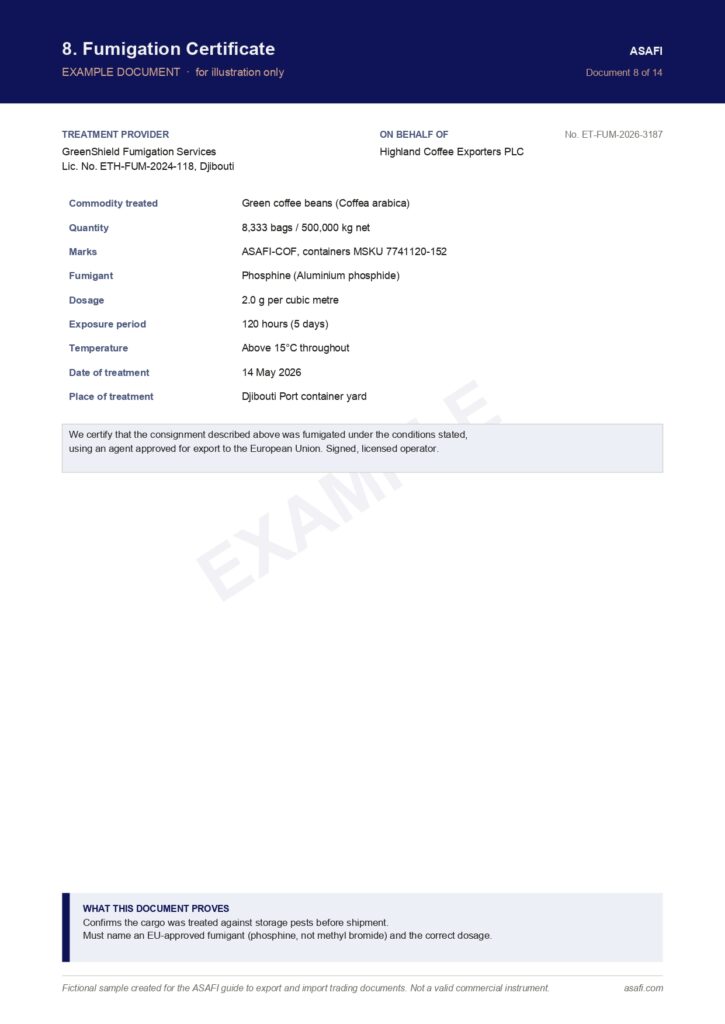
The fumigation certificate confirms that the commodity has been treated to eliminate storage pests before export.
It is required for most grains, pulses, sesame, and raw cashews, especially when shipped in bags rather than bulk.
It records the fumigant used, the dosage (in grams per cubic meter), the exposure duration, the date of treatment, the name and certification number of the fumigation operator, and the goods treated.
EU rules specify acceptable fumigants. Methyl bromide is restricted in the EU and several other destination markets. Phosphine (aluminium phosphide) is the standard for most African agricultural exports. The certificate must state the correct chemical name rather than a trade name.
Failure grounds include a fumigant not approved by the destination market, a dosage below the required threshold, a certificate issued by an uncertified operator, or a treatment date too early relative to the loading date.
See the example: Document 8 in the attached pack.
9. The Inspection Certificate (Certificate of Quality and Weight)
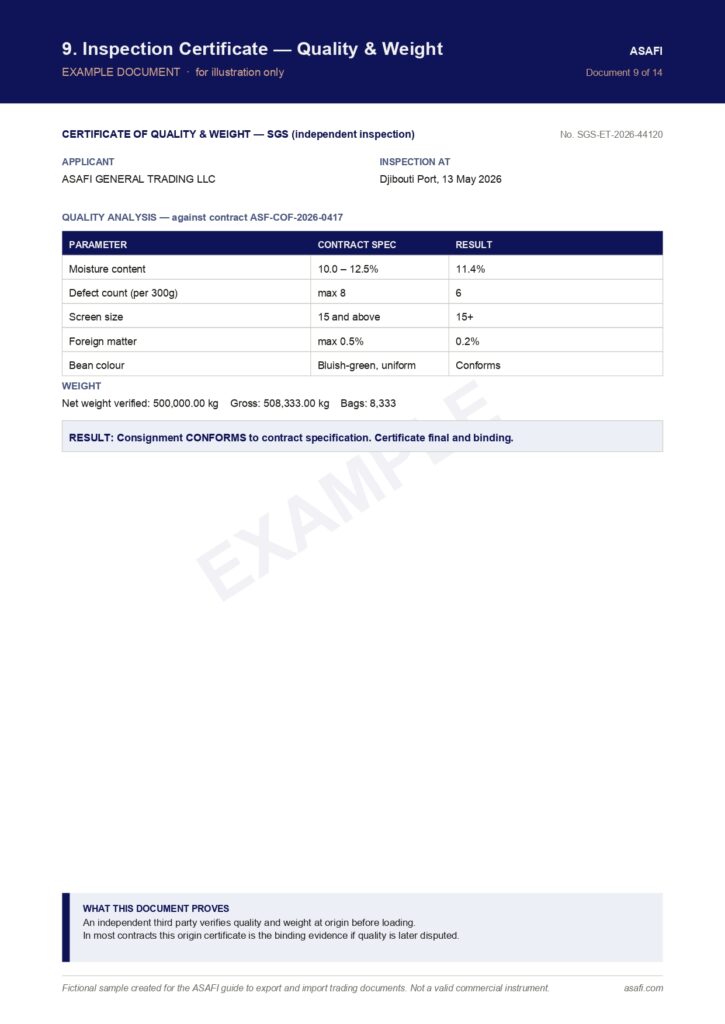
The independent inspection certificate is issued by a third-party inspection company — SGS, Bureau Veritas, Cotecna, or equivalent — after physical examination of the cargo at origin.
It records commodity identity, grade, moisture content, foreign matter percentage, defect count, net weight, gross weight, number of bags, container seal numbers, and the date and location of inspection.
The inspection company draws samples according to a defined sampling procedure, tests them against the contract specifications, and issues a certificate stating whether the goods comply.
In most commodity contracts, the origin inspection certificate is the binding reference for quality and weight. If the buyer disputes quality at destination, the origin certificate is the primary evidence. This makes the contract language on which certificate governs a commercial decision, with weight far beyond procedure.
When origin and destination inspection results disagree, the contract's dispute resolution clause determines what happens next — typically a jointly appointed umpire inspector, with costs borne by the losing party.
See the example: Document 9 in the attached pack, with quality results set against contract spec.
10. The Insurance Certificate
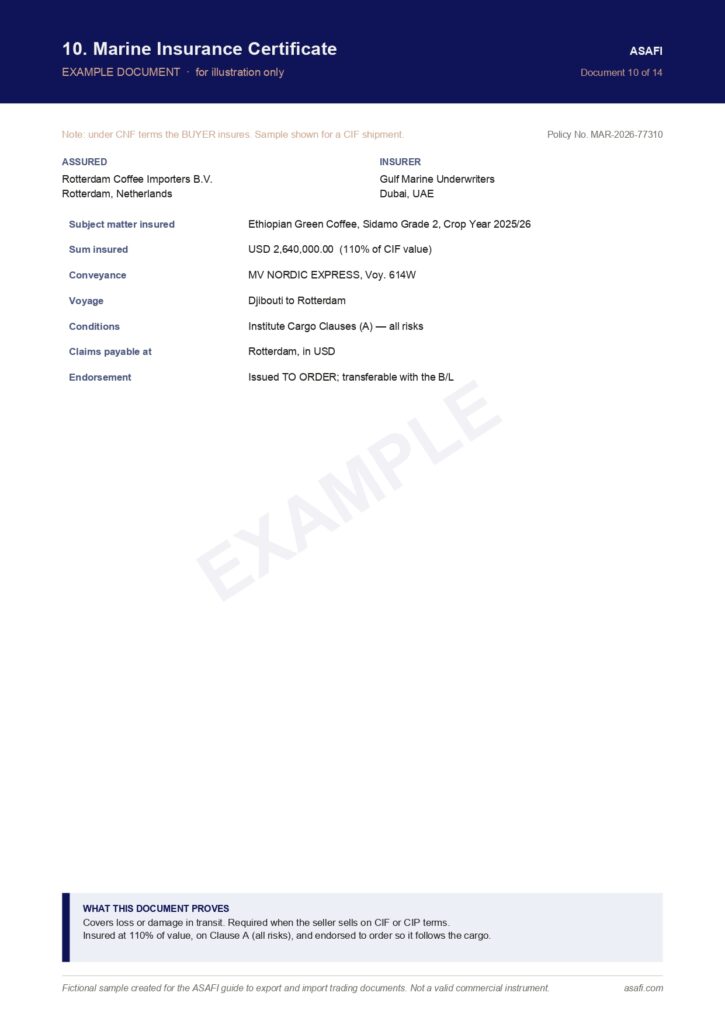
The insurance certificate confirms that the goods are covered against loss or damage in transit.
It is required under CIF and CIP Incoterms, where the seller arranges insurance. Under FOB and CFR, the buyer arranges their own cover.
It states the insured party, insured value (typically 110% of invoice value under standard commodity practice), coverage scope (Institute Cargo Clauses A, B, or C, with A being the broadest), voyage, and policy number.
Clause A covers all risks except war, strikes, and specific exclusions. Clauses B and C cover only named perils. Most commodity buyers require Clause A.
The insurance certificate must be issued or endorsed to order so that it can transfer to the buyer alongside the B/L. An insurance certificate made out to a named party only cannot transfer and counts as a discrepancy under an L/C.
See the example: Document 10 in the attached pack.
11. The Customs Export Declaration
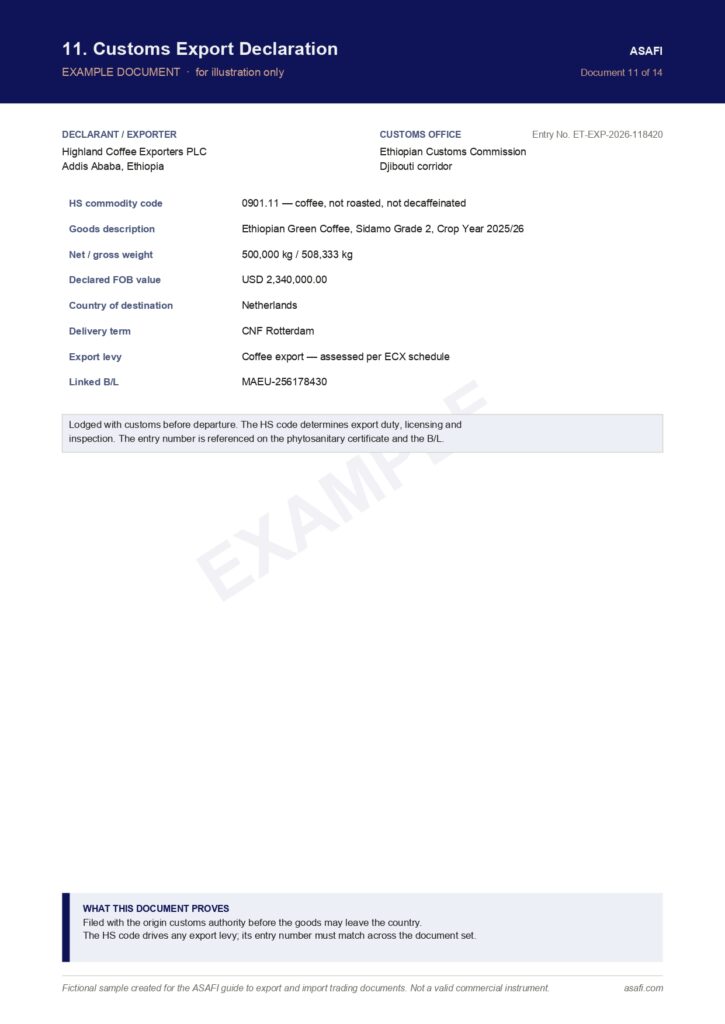
The customs export declaration is filed with the exporting country's customs authority before the goods leave the country.
It records exporter details, commodity HS code, declared value, weight, destination, and Incoterm.
The HS (Harmonized System) code determines whether the export is subject to export duty, export license requirements, or government inspection. Several African governments apply export levies to raw commodities as an incentive for domestic processing — Tanzania and Mozambique on raw cashews, for example. The correct HS code directly affects the cost of exporting.
The customs export declaration generates the export entry number, which is referenced in the phytosanitary certificate and appears on the Bill of Lading. These references must stay consistent across documents.
See the example: Document 11 in the attached pack.
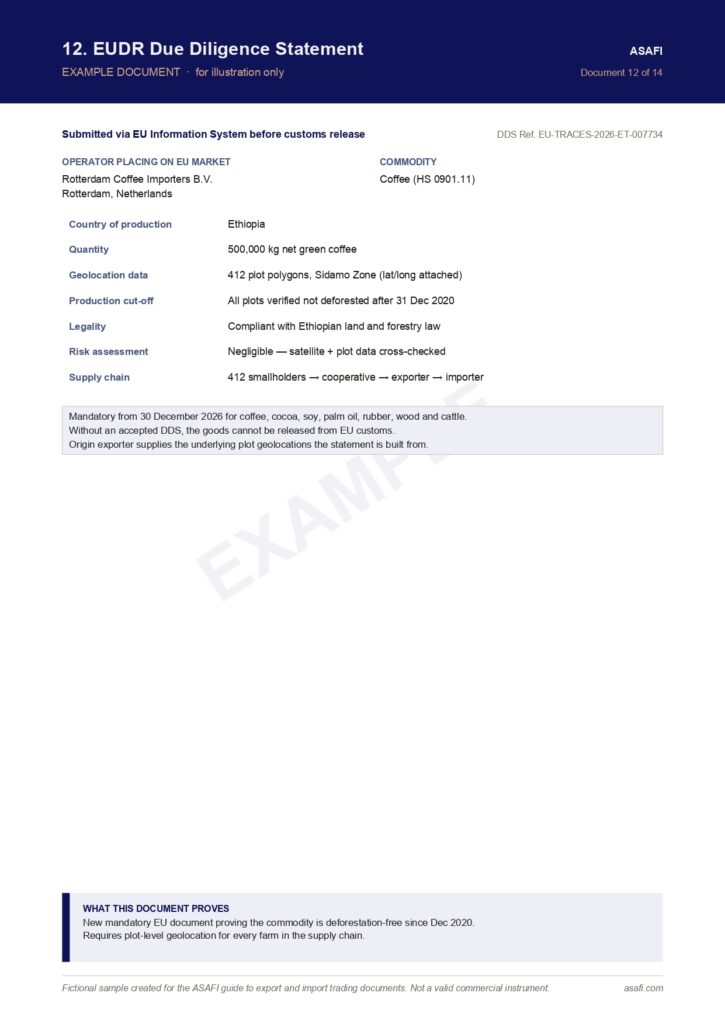
12. The EUDR Due Diligence Statement
From December 30, 2026, any operator placing coffee, cocoa, cattle products, palm oil, rubber, soy, or wood on the EU market must submit a Due Diligence Statement through the EU's Information System before customs clearance.
It contains geolocation coordinates of every plot of land where the commodity was produced, a risk assessment confirming the land was not deforested after December 31, 2020, a statement of compliance with the laws of the country of origin, and the identity of all operators in the supply chain from producer to first EU market operator.
The DDS is generated in the EU Information System by the first operator placing goods on the EU market. The exporter at origin must supply the underlying data — farm-level geolocations and legality documentation — that the DDS is built from.
A missing or incomplete DDS means goods cannot be released from EU customs. For coffee and cocoa from Africa, the data collection chain runs from smallholder farmers (who may farm plots under 2 hectares and hold no formal land registration) through cooperatives, local exporters, and international traders to the EU importer. Each link in that chain must capture and pass on the required data.
See the example: Document 12 in the attached pack.
13. Supplementary Documents by Transaction Type
Some transactions require additional documents beyond the standard set.
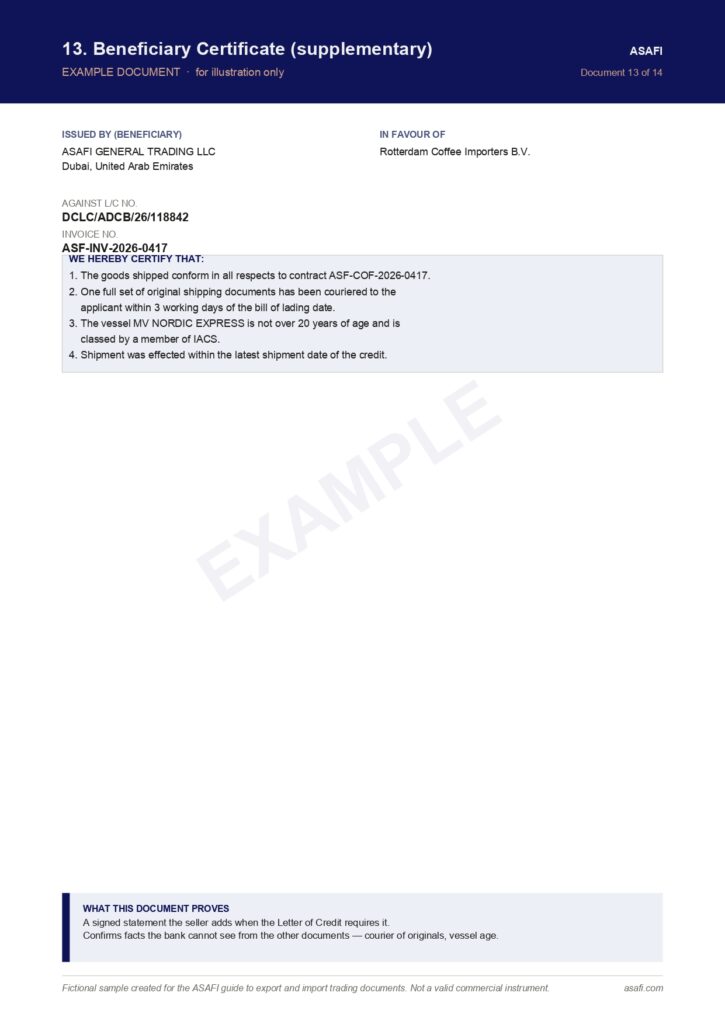
For letter of credit transactions: a beneficiary certificate (a signed statement by the seller confirming shipment and compliance with contract terms), sometimes required by the L/C alongside the standard document set.
For EU preference tariff claims: Form A, EUR.1, or a REX declaration, depending on which agreement covers the country of origin.
For specific commodities: a health certificate for animal products, an organic certification from an accredited body for certified organic goods, or a fair trade certificate where the buyer's contract requires it.
For bank-financed transactions: a warehouse receipt or a collateral management agreement, where goods in storage serve as security for a trade finance facility.
See the example: Document 13 in the attached pack, showing a beneficiary certificate.
And finally, here is the list of all the docs we shared with you today, We hope you found this helpful.